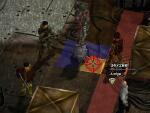
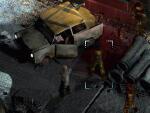
The Geryk Analysis: Odium vs. Shadow Watch (cont'd)In Odium, you do indeed get more stuff. You find a flamethrower thing, and gleefully set monsters on fire, until you find that some monsters are immune to fire (role-playing alert) and have to use a different weapon against them. You learn to hoard ammo for certain guns, and switch weapons in combat so as to preserve precious long-range weaponry. And every now and then, you get weapons that help you solve some particularly difficult combat, as long as you’re smart about how you use them. The flamethrower sets things ablaze and causes damage over multiple combat rounds. There’s that gun that shoots an energy beam and can take out an entire row of guys, including your own if you’re not careful. Every time you find a new weapon or item, you can’t wait to see what it does. It’s wicked.
In Shadow Watch, you get dick for new stuff.
One of the few weaknesses Odium has is that it’s not replayable, since it’s linear and relies on your anticipation of new challenges to keep your interest. However, Shadow Watch is also not replayable, because it isn’t even playable – you can’t play it a second time because you probably won’t get through it the first time. So I guess on that point, the games are tied. Congratulations.
A turn-based tactical-level game needs to divide its battles into a reasonable number of slices of time so that each turn is interesting yet the game doesn’t move too fast or give an overwhelming advantage to the side that happens to move first. Graduates of Computer Game Story School will recognize this as “pacing.” Surprise: pacing is just as important for manly-man tactical military games as it is for all those games your girlfriend’s annoying roommate likes because they tell stories and are non-violent. If you don’t count vampires as violent, which I don’t. Anyway.
A good rule of thumb that I just made up right now is that there should be something meaningful for each character or unit to do in every turn. This doesn’t have to be actually firing a weapon. It can be dashing across a street, climbing a building, outflanking an enemy, getting out of the fucking way, or whatever. Something that makes a difference.
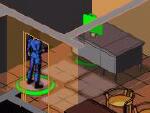
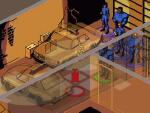
Shadow Watch fails this test miserably, to the point that there will be some turns when the only thing your characters will be doing is … kneeling. I mean all of your characters, not just the Catholics. In Odium, you find yourself planning a couple turns ahead, so as to trap an elusive monster in a crossfire between your maneuvering soldiers. In Shadow Watch, you’re looking forward either to five turns from now – when you just may be able to get through that door that is two squares away – or dinner. Let’s not even talk about the fact that once the mission is over, you have to move everyone back to the exit, one turn at a time.
Both Odium and Shadow Watch take place on fairly small maps. This has huge implications for tactical combat, because as many disturbed-individuals-turned-disgruntled-investors have learned, if you’re trying to kill someone, the kind of gun you’re using doesn’t really make any difference if you’re standing in his office. Thus, weapon differences (which are a major part of larger-scale tactical games like Jagged Alliance 2) become irrelevant from a realism perspective. In addition, as the scale gets smaller, the number of actions a unit can take has to decrease, or there are no decisions to make – you simply do everything. Run through the door, shoot that guy, take cover, reload, etc. No planning required. Shadow Watch tackled this problem by just chopping time up into such small segments that each turn became incredibly boring. Odium used another approach entirely.
|