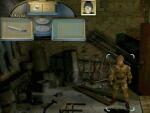
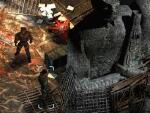
The Geryk Analysis: Odium vs. Shadow Watch (conclusion)In Odium, weapons have very stylized zones of fire. Pistols can only shoot orthogonally, while rifles have the additional capability of firing along the diagonal. The orthogonal vs. diagonal dichotomy is an incredibly elegant way of making a range distinction between two weapons without using a lot of map space. The reason for this is that due to the concept of angular velocity, you don’t have to move as far to engage someone on the diagonal as you do orthogonally. Thus, you can be much farther away to use a rifle effectively, while with the proper combination of obstacles, a pistol shouldn’t be effective from more than a couple squares away because that’s how close you have to get to be on the same row of squares as your opponent with an unblocked line of sight. Regularizing firelanes on the map grid makes it possible to highlight weapon differences (albeit in an abstract, “unrealistic” way) and turn them into a tactical consideration. Combined with the fact that some map objects (like gasoline barrels) can be detonated by gunfire, the stylized combat system requires a great deal of strategy. Of course, it also runs the risk of offending people who insist that “rifles don’t shoot diagonally.”
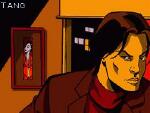
The funny thing is that Shadow Watch has this completely unrealistic square grid as well, but I guess this is ok if it fits well into this “all-blue comic book” art motif. Fine. Give the artists and art director credit – Shadow Watch has more style and better art direction than Odium. Unfortunately, it seems that the Art Director pretty much ran roughshod over the Director of Making the Game Possible to Play Without Becoming Exasperated, because when combined with the isometric perspective, the artwork manages to make the line of sight completely unworkable. You can never quite tell what your characters can see, or where an enemy could be hiding, or which squares are even playable. It’s hella annoying.
Because of this, Shadow Watch is a painful crawl through every level in which your agents have to move very slowly, kneel down a lot, cover each other, and essentially inch their way through each mission. Because of the horrible action-point imbalance (pacing!) mentioned earlier, each turn is only marginally interesting because very often you do nothing of note. If the weapons are all the same, and movement is divided up into such small slices that it’s all the same, then what makes Shadow Watch engaging? Comic-book art? Wouldn’t it make more sense to just read a comic book? I don’t know, I’m just asking.
Odium avoids all of these problems. You can see where the enemy is, you can see where you’re going, you can fire and move in each turn, the battles are interesting, and the puzzle-like nature of the game gives you a lot to think about with a minimum number of extraneous details. This provides everything you could reasonably expect from a game, and the story elements support the tactical combat with new items, unexpected monsters, etc. Just like I said. Brilliant.
Right about here, I’d sum up by saying that overall, Odium and Shadow Watch each have good and bad points, and that while neither one is a classic like X-COM, if you like this type of game you may or may not like Odium and/or Shadow Watch. But since that would almost certainly get me a call from Adrenaline Vault’s lawyers, I’ll reiterate my original point: Odium has game design in spades. Shadow Watch has art design. If you haven’t head a chance to play either of these games yet, I hope it’s clear which one deserves your hard-earned money. For great justice.
|