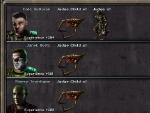
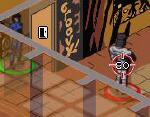
The Geryk Analysis: Odium vs. Shadow Watch (cont'd)When it comes to looking cool, both Odium and Shadow Watch have some problems. Odium’s 3D presentation looks much better on the adventure map than it does in the tactical battles. Shadow Watch has an interesting hand-drawn, comic-book style, but undermines this with an inconsistent sense of aesthetics where people who get shot flop over like Shemp Howard and your objective is neon green floating luggage. Nevertheless, both games are visually appealing enough to satisfy criterion number three. That brings us to the real game design element: presenting gamers with non-trivial decisions.
Whether a game is about fantasy monsters or the other kind, you only have to look as far as the classic X-COM for a fundamental truth about this genre: it’s not all about the tactical combat. Shooting guys with little itty-bitty guns is a blast, yes, but unless there is a sense of discovery, you’re simply replaying the same set-piece battle over and over. That gets old very fast. You can change the maps around and introduce new monsters and weapons, but for this to make any sense it has to be within the context of a story.
Odium takes a pretty conventional path through the game’s story, but one that does a good job of providing the tactical element with hooks necessary to make the game involving not just as a combat exercise, but also as a developing series of events. It doesn’t matter that the events add up to a dumb story. All computer game stories are dumb. It’s the law. The point is that the combination of anticipation and tactical decisionmaking keeps you involved even in the face of the hackneyed “secret experiments gone wrong” premise. That’s the strength of Odium: the plot progression helps make the other parts of the game engaging.
Shadow Watch’s story is simply irrelevant. As an experiment, whenever I was presented with a choice of missions, or the need to question non-player characters, I took a friend’s advice and closed my eyes while throwing my mouse in the vague direction of a large photo on my wall of former White House chief of staff Bob Haldeman. You know what? It didn’t matter. No matter what choices I randomly selected by smashing my mouse against my favorite Watergate felon’s visage, I got to go on the missions, and I never needed to find out why. Shadow Watch hadn’t learned the lesson that Baldur’s Gate should have taught to all the games it met socially: text boxes for dialogue only work in role-playing games based on the magic of elvenlore. All that reading doesn’t do anyone any good, especially if you’re just going to keep meeting the same enemies every time. Which, in Shadow Watch, you do.
Shadow Watch severely underestimates the story value in a game. This doesn’t just refer to the “why things are happening” part. It also includes the things that happen within the game. Empire-building games with tech trees create a powerful desire for new technology (“If I can just get Chariots, I can smoke him!”) that is never quite satisfied (“If I can only get Chariots and Catapults, then I can smoke him!”). When playing games with individual characters instead of massive empires, this lament becomes, “If only I had a submachine gun. Or a +1 broadsword.” Or a fucking life. Whatever. The point is, you want more stuff because it allows you to progress further in the game. Thus, when you get more stuff, you’re happy. This is really the whole point of life, which is why Richard Mellon Scaife bought Pittsburgh.
|