The Geryk Analysis
|
 |
 |
 |
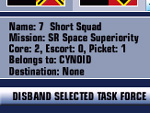
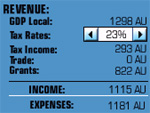
Imagine, for example, a viceroy who is managing a planet in some part of your empire where you're generating a lot of trade income, thanks to nearby Klackon spaceports. You decide that there are some regions on some of these planets that need to be developed for industry, because you are going to be launching an attack on the Klackons. However, your viceroy sees that if he simply developed more Recreation and Spaceport DEA's, he could increase his trade and thus make more money (some percentage of which was going into his pockets through graft). So he ignores your orders to build mines and factories, and builds amusement parks instead.
In a game with infinite micromanagement, you simply go to those planets, uncheck the viceroy box, assign the DEA's yourself, curse the bad AI, and move on. But if your ability to intervene is limited by something like Imperial Focus Points, you have to decide: do I waste time straightening this guy out? Or do I ignore him and try to get the production points somewhere else? In a good design, each of these would have consequences: meddling with a popular viceroy who is enriching the worlds he controls through trade would anger the populace, who would resent imperial meddling at their expense; removing him outright may even trigger a revolt. Leaving him alone might embolden other viceroys to follow his lead, so that the more tolerant you get of disobedience, the less the AI follows your orders. If your viceroys had personalities like your leaders, it would be even better.
 |
 |
 |
It may sound like this is just excusing bad AI, but as I said above, this whole thing is dependent on the AI doing things that make sense for role-playing reasons, which is another way of saying that you can explain them in game terms that don't resort to "the viceroy is insane" or "the viceroy just likes building lots of transports but no troops to put in them." Like the "favorable trade relations" example above: the planet is happy and is making money for everybody. Now you, the mean emperor, want it to start making warships to attack your trading partner. If you want to upset the status quo that much, you're going to have to devote a lot of attention to this. You're going to have to use a lot of Imperial Focus Points that you would otherwise have used to do other things.
In this case, note that abstraction works against you as a designer.
I guarantee that no matter how well you justify it in scary role-playing
terms, no player is going to be very happy when you move the Shipbuilding
slider from 10% up to 60%, and the next turn it's right back at
10%. It will seem artificial and broken. However, if you create
a system that goes into enough detail where it is possible for the
AI to partially follow your orders, you can get away with
it.